Verified Relay · Service 05

Move repeatable work without hiding authority or exceptions.

NorthWorx maps, tests, and monitors practical AI-assisted and rules-based workflows while keeping important decisions, access, failures, and handoffs visible to people.

  1. Receive
  2. Verify
  3. Owner checkpoint
  4. Approved action
  5. Visible record

Primary value

Automate the stable, repeatable parts of a workflow and make the human-control boundary unmistakable.

The service is designed around understandable business value, visible limits, and a useful next decision—not a pile of technical tasks.

01

Less repeated coordination

Route routine information and follow-up steps when the rules and data are ready.

02

Visible decision rights

Document which actions can proceed, which require approval, and where exceptions go.

03

Testable operations

Treat workflows as maintained systems with logs, failure paths, and owners—not magic.

Explore the opportunity

Not sure whether automation would actually pay for itself?

Estimate the value of faster lead response and less repetitive work using your own operating assumptions.

Calculate Your AI Opportunity

Service scope

Automate only after the operating boundary is clear.

NorthWorx can help identify opportunities and design the relay. Exact tools, integrations, data categories, access, maintenance, and support are project decisions.

  • Opportunity and repeatability assessment
  • Workflow, authority, and exception mapping
  • Data and access inventory
  • Prototype, test cases, and human checkpoints
  • Monitoring, records, failure behavior, and maintenance plan

How the work moves

A visible path from baseline to improvement.

Each stage produces an understandable decision or record. The process can stop when the next step is not supported by evidence, access, or authority.

  1. 01
    Choose a stable problemConfirm that the work repeats, matters, can be accessed appropriately, and has rules people can explain.
  2. 02
    Define authorityMap data, actions, approvals, exceptions, owners, and what must never happen automatically.
  3. 03
    Prototype and testUse controlled scenarios, including failures and ambiguous inputs, before real operating use.
  4. 04
    Monitor and maintainKeep outcomes, provider changes, exceptions, and required human follow-up visible.

Default engagement

Assess one repeated task. Prototype inside a controlled boundary.

  1. 01Identify one repeated task and its responsible owner
  2. 02Document the current human process and actual bottleneck
  3. 03Confirm value, stability, access, inputs, decisions, exceptions, and success criteria
  4. 04Map the trigger, workflow, authority boundaries, human checkpoints, and failure paths
  5. 05Build a controlled prototype using synthetic or specifically approved non-production information
  6. 06Test success, failure, ambiguity, duplicates, delays, unauthorized attempts, and unavailable providers
  7. 07Deliver findings, limitations, risks, maintenance needs, and a production-readiness recommendation

Non-production prototype: The prototype is not live, autonomous, connected, continuously monitored, or approved for customer use. Production implementation, external messaging, customer data, live providers, and ongoing management require separate scope, review, testing, and activation authorization.

Appropriate first examples

Start with work people can explain and review.

  • Internal task and information routing
  • Checklists and status coordination
  • Draft preparation from approved business facts
  • Human-reviewed response or content drafting
  • Record formatting, categorization, and summarization
  • Internal reminders and exception alerts
  • Preparing—but not automatically sending—approved follow-up
  • A synthetic customer-inquiry, missed-call, or appointment-request demonstration with no real customer or production channel

Standard assessment and prototype

Map the route, authority, failure, and record.

  • Current-process and bottleneck review
  • Trigger, input, rule, action, output, and exception mapping
  • Data-category and access inventory
  • Human decision and approval checkpoints
  • Authority and responsibility mapping
  • Provider and integration dependency review
  • Synthetic test scenarios
  • Failure, retry, duplicate, timeout, idempotency, and unavailable-provider behavior
  • Logging and audit-record requirements
  • Prototype limitations and production-readiness findings
  • Maintenance, ownership, support, and handoff recommendations
  • Responsible estimates of cost, provider, and usage dependencies where possible

Separate evaluation and authorization

Higher-impact work needs a higher evidence bar.

  • Production account or provider connections
  • Email, SMS, telephone, chat, booking, or customer-contact workflows
  • Customer or employee personal information
  • Payments, refunds, pricing decisions, or financial actions
  • Contract, legal, medical, safety, eligibility, insurance, or employment decisions
  • Authentication, permissions, access control, or security enforcement
  • Deleting, overwriting, or materially changing records
  • Public publishing
  • Customer profiling or consequential scoring
  • Sensitive or regulated information
  • Autonomous promises, obligations, appointments, purchases, or other business commitments
  • AI agents that independently select tools or act beyond a narrowly approved workflow

Prototype boundary: Passing tests does not authorize production use.

Information classification

Classify before use.

  • Public business information
  • Approved internal operating information
  • Confidential business information
  • Customer or employee personal information
  • Sensitive or regulated information
  • Reusable credentials and secrets

Required data record

Document purpose, custody, permission, and exit.

  • Purpose
  • Source
  • Owner
  • Permitted use
  • Provider access
  • Storage location
  • Retention expectation
  • Deletion or return responsibility
  • Applicable consent or authorization
  • Whether production use is permitted

Least-privilege access: Use official invitations, OAuth, delegated roles, service accounts, or separately approved secure connections. NorthWorx never requests passwords, 2FA or recovery codes, API secrets, private keys, payment-card information, or reusable credentials through ordinary forms, surveys, email, chat, or project documents.

Initial operating stage

A person approves consequential or outward action.

  • Send an external communication
  • Make a promise or commitment
  • Change an important customer or business record
  • Publish content
  • Change access or permissions
  • Make a financial decision
  • Delete information
  • Handle a complaint, dispute, safety issue, legal issue, or ambiguous exception

Possible future low-risk action

Authorize the exact action—not general autonomy.

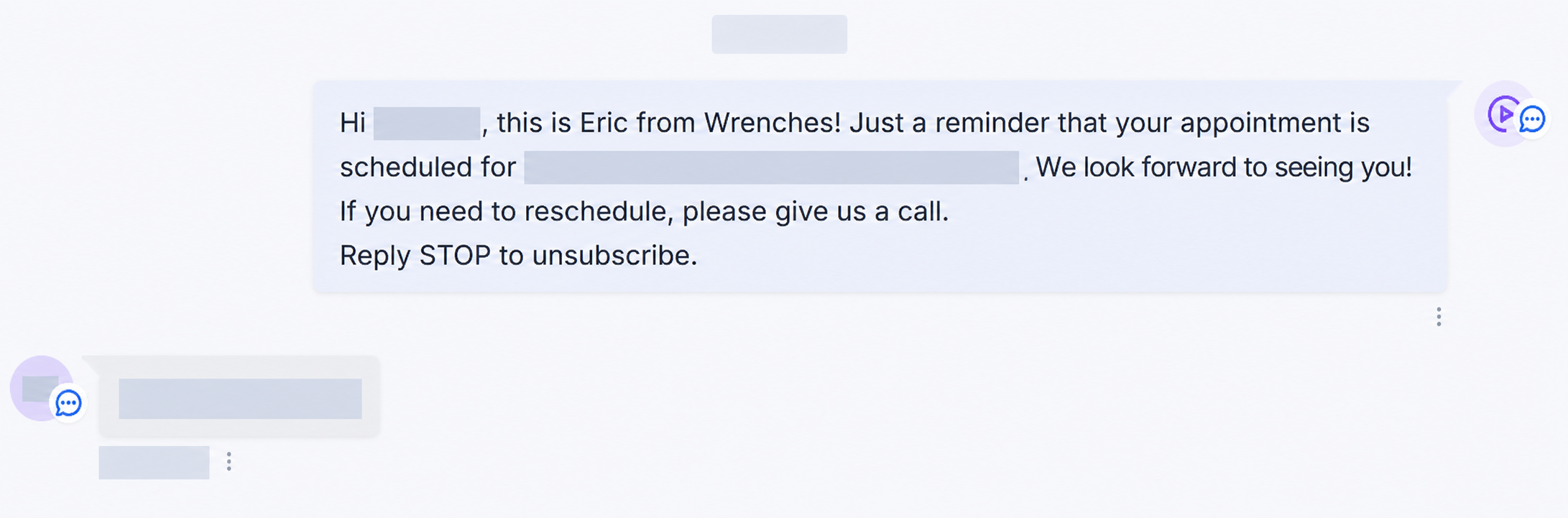
A future agreement may permit a narrowly defined action such as a preapproved missed-call acknowledgment or appointment-confirmation message only after every gate below is complete.

  • A2P and channel-specific approval where applicable
  • Documented consent and opt-out handling
  • Approved wording and sending identity
  • Narrow trigger and recipient-eligibility rules
  • Duplicate and frequency protections
  • Quiet hours and suppression handling
  • Synthetic and controlled production testing
  • Logging and auditability
  • Named human owner and escalation route
  • Pause and shutdown controls
  • Monitoring and maintenance responsibility
  • Separate written production-activation authorization

Future authorization applies only to the exact reviewed action and does not create general permission for autonomous messaging or other business commitments.

Fail safely

Stop or route uncertainty to a named person.

A workflow must not silently continue, guess, fabricate missing information, repeatedly retry without limits, or take a higher-impact action when its operating basis fails.

  • Provider failure
  • Uncertain input
  • Missing authority
  • Duplicate risk
  • Unavailable data
  • Failed validation
  • Policy conflict
  • Unexpected output

Eight-part delivery record

Acceptance confirms the prototype—not production authority.

Written acceptance confirms only that the non-production prototype materially matches its approved specification and that its documented limitations are understood. Every production action still requires separate scope, configuration review, testing evidence, provider and legal requirements, and explicit activation authorization.

  1. 01

    Current-process map

    Existing steps, responsible people, bottlenecks, exceptions, and the current fallback.

  2. 02

    Information and access register

    Data categories, sources, owners, permitted uses, providers, retention expectations, and approved access methods.

  3. 03

    Workflow and authority specification

    Triggers, inputs, rules, actions, outputs, human checkpoints, prohibited actions, escalation paths, and shutdown controls.

  4. 04

    Controlled non-production prototype

    A bounded demonstration using synthetic or specifically approved non-production information.

  5. 05

    Test evidence

    Successful, failed, ambiguous, duplicate, delayed, unauthorized, invalid, and unavailable-provider scenarios.

  6. 06

    Limitations and risk record

    Known gaps, provider dependencies, security considerations, maintenance needs, and unresolved decisions.

  7. 07

    Production-readiness recommendation

    A clear ready, conditionally ready, not ready, or outside-NorthWorx-scope conclusion—with reasons and remaining conditions.

  8. 08

    Client review and written prototype acceptance

    Confirmation that the non-production prototype materially matches its approved specification and its documented limitations are understood.

Prototype acceptance does not authorize

  • Production deployment
  • Live-provider connections
  • Customer or employee data use
  • External communication
  • Public publishing
  • Record modification
  • Appointment booking
  • Financial activity
  • Access or permission changes
  • Any automated business commitment

Proposal-specific ongoing management

Manage only the named workflows inside a written allowance.

The agreement defines the workflows, providers, cadence, allowance, approvals, responsibilities, costs, exclusions, renewal, cancellation, and handoff terms. Nothing here implies continuous monitoring or unlimited support.

Possible included work

Review evidence and improve carefully.

  • Scheduled log and error review
  • Provider or integration-change review
  • Controlled retesting
  • Approved small improvements
  • Documentation updates
  • Review of recurring exceptions and failure patterns
  • Verification of pause, escalation, and shutdown controls
  • Decision-oriented reporting

Agreement requirements

Define responsibility before recurring work begins.

  • Covered workflows and providers
  • Review cadence and included work allowance
  • Response expectations
  • Change-approval process
  • Logging and retention responsibilities
  • Client responsibilities
  • Provider and usage costs
  • Exclusions
  • Renewal, cancellation, and handoff terms

Ongoing-service limits

  • No continuous active monitoring
  • No unlimited improvements
  • No emergency response or 24/7 support
  • No guaranteed availability or provider behavior
  • No guaranteed prevention of failures

Cancellation and handoff

Transfer responsibility with a complete operating record.

NorthWorx does not disable a working production workflow, delete records, revoke client-owned access, or remove a provider connection without explicit authorization and a verified target. A separately agreed emergency safeguard may permit only its specifically bounded protective pause.

  • Workflow purpose and current status
  • Trigger, inputs, actions, outputs, and exceptions
  • Human owners and approval points
  • Data categories and permitted uses
  • Delegated permissions and provider connections
  • Third-party providers, subscriptions, usage limits, and costs
  • Logs, audit records, and retention responsibilities
  • Known limitations and unresolved items
  • Maintenance and testing needs
  • Ownership and licensing boundaries
  • Pause, disablement, rollback, and shutdown procedures
  • Authorized access-removal process
  • Responsibilities after the handoff date

Standard-service exclusions

Bound the system before it can create a larger risk.

Separate evaluation does not make a prohibited activity appropriate, prove an outcome, include third-party costs, or authorize production.

  • Autonomous legal, medical, safety, employment, eligibility, insurance, credit, or other high-impact decisions
  • Unapproved external communications
  • Autonomous promises, appointments, purchases, refunds, pricing decisions, or contractual commitments
  • Collection or handling of passwords, recovery codes, two-factor codes, private keys, payment-card data, or reusable credentials through ordinary channels
  • Destructive record changes or deletions without specific approval and safeguards
  • Deceptive, impersonating, fraudulent, manipulative, or misleading activity
  • Fabricated facts, identities, reviews, messages, records, or outcomes
  • Consent, privacy, security, access-control, A2P, or platform-policy evasion
  • Silent continuation after missing authority, failed validation, uncertain input, duplicate risk, or provider failure
  • Unsupported claims of saved time, reduced costs, improved revenue, increased bookings, accuracy, reliability, or other outcomes
  • Emergency response, continuous monitoring, or 24/7 support
  • Unscoped provider subscriptions, messaging charges, usage fees, software licenses, or third-party costs
  • General-purpose autonomous agents with unbounded tools, permissions, or decision authority

Conceptual proof set

Inspect authority, failure, and handoff without mistaking a demonstration for safety or results.

These static, NorthWorx-owned examples use fictional, privacy-safe information. They contain no real customer, employee, credential, provider, or production information; imply no live integration, provider endorsement, or guaranteed outcome; and remain understandable without animation, interaction, or color alone.

Conceptual Example

Verified Relay workflow and authority diagram

A fictional route showing a synthetic trigger, a named human checkpoint, exception handling, prohibited action, and a visible pause state.

  1. Trigger
    Synthetic request receivedSource: fictional sample contact
  2. Validate
    Required fictional fields presentDuplicates and authority checked
  3. Human
    Named approver reviews the draftNo external communication
  4. Exception
    Uncertain input stops and routesNo guessing or silent continuation
  5. Pause
    Owner-controlled shutdown availableProduction action prohibited

NorthWorx-owned fictional example. No real customer, employee, credential, provider, production information, live integration, provider endorsement, safety proof, business result, or production authorization.
Conceptual Example

Fictional failure-test matrix

A privacy-safe sample showing expected stop, escalation, duplicate, delay, authorization, validation, and provider-failure behavior.

Fictional case: privacy-safe sample record

Duplicate
Stop · log · route
Invalid input
Reject · explain
Unauthorized
Block · escalate
Provider unavailable
Pause · bounded retry
Delayed result
Hold · human review

NorthWorx-owned fictional example. No real customer, employee, credential, provider, production information, live integration, provider endorsement, safety proof, business result, or production authorization.

Sample Deliverable

Production-readiness and handoff report

A sanitized record separating prototype evidence, unresolved conditions, production authority, maintenance ownership, and shutdown instructions.

  1. Prototype

    Demonstration completed with fictional data.

  2. Readiness

    Conditionally ready; listed controls remain open.

  3. Authority

    Production activation not granted.

  4. Outcome

    No time, cost, booking, revenue, or reliability result claimed.

  5. Handoff

    Human owner, pause, rollback, and shutdown recorded.

NorthWorx-owned fictional example. No real customer, employee, credential, provider, production information, live integration, provider endorsement, safety proof, business result, or production authorization.

Trust through clear limits

Verified Relay is a process model—not a certification

These boundaries protect the business from overpromising and keep the service understandable for owners and customers.

  • No unsupported security, compliance, accuracy, autonomy, or cost-saving claim
  • No production connection without approved access and data handling
  • No consequential action outside its defined authority
  • No assumption that AI is the right tool for every workflow

Service questions

What owners usually need to know first.

What should a local business automate first?

Start with repeated work that has clear value, stable inputs, available access, explainable rules, manageable exceptions, and an owner. The automation checklist in Resources expands this test.

Will AI make decisions for the business?

Only actions inside an explicitly approved boundary should proceed automatically. Consequential, ambiguous, or exceptional choices should route to a person.

Which tools can NorthWorx connect?

Supported integrations depend on the workflow, account access, provider capabilities, data sensitivity, reliability, and maintenance plan. No universal production list is approved yet.

Does a successful prototype mean the workflow is ready to go live?

No. A prototype is non-production evidence. Production access, providers, customer information, communications, testing, monitoring, maintenance, and activation require separate review, scope, and written authorization for the exact approved action.

Can a future workflow send an automatic message?

Potentially, but only for a narrowly defined low-risk action after channel approval, consent and opt-out controls, approved wording and identity, strict eligibility and frequency rules, testing, logs, a human owner, pause controls, maintenance responsibility, and separate activation authorization are complete. That does not authorize general autonomous messaging.

Choose the next step

Bring one repeated task—not a request to automate everything.

NorthWorx can help determine whether the workflow is stable, valuable, accessible, and safe enough to prototype.